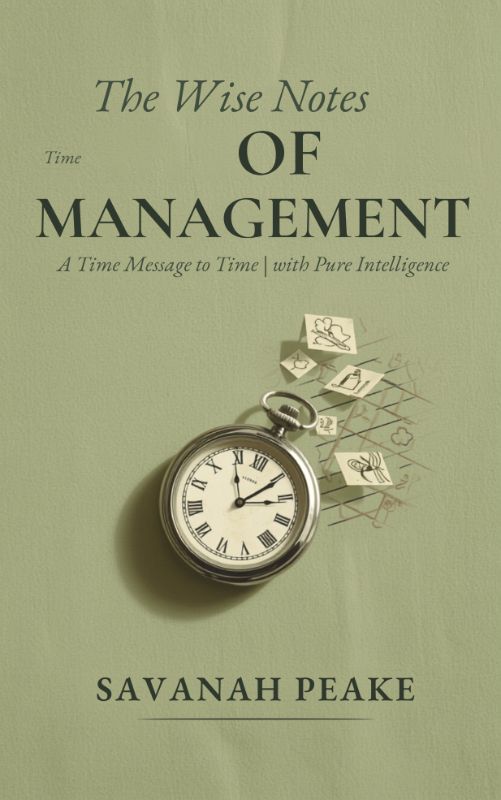
Time is the silent architect of our lives, quietly shaping our days, our ambitions, and our destinies. It is the canvas on which we paint our achievements, the currency we exchange for memories, and the ever-flowing river that carries us from one moment to the next. Yet, for many, time management remains an elusive skill—a mysterious art practiced by the few, while the rest of us wrestle with overflowing calendars, missed deadlines, and a perpetual feeling of being just a step behind.
The Wise Notes of Time Management was born from this universal struggle. It is not merely a book of tips and tricks, nor a dry collection of productivity hacks, but a deeply considered guide for transforming your relationship with time itself. Whether you are a student balancing academic demands, a professional scaling the heights of your career, an entrepreneur juggling innovation and execution, or someone simply striving to find more peace and fulfillment, this book is your companion on the journey toward mastery over your most precious, non-renewable resource.
The Universal Challenge of Time
Across cultures and generations, time has always been a paradox—abundant and yet scarce, equally distributed and yet differently valued. Every person on the planet receives the same twenty-four hours each day, but the outcomes of those hours could not be more diverse. Some seem to command time with effortless grace, packing their days with meaningful achievements and still finding space for rest and relationships. Others, despite frenzied effort, feel as if the day slips through their fingers like grains of sand.
This sense of scarcity is not merely a modern phenomenon. Ancient philosophers, from Seneca to Confucius, grappled with the fleeting nature of life. In our digital age, however, the pace has accelerated. Information overload, constant connectivity, and the blurring of work-life boundaries have made it more challenging than ever to manage our time with intention and clarity.
Why Time Management Matters
At its core, time management is not simply about squeezing more tasks into a day or achieving an artificial sense of productivity. It is about aligning your actions with your values. It is about making conscious choices that reflect who you want to be and what you wish to contribute to the world. Poor time management does not just lead to missed appointments—it can erode self-confidence, strain relationships, and sap the joy from our pursuits.
Conversely, wise time management can be a transformative force. It enables us to:
Prioritize what truly matters
Reduce stress and improve well-being
Enhance our capacity for creativity and innovation
Build enduring habits that compound over time
Achieve ambitious goals while maintaining balance
This is not a call to relentless hustle, but an invitation to intentional living.
The Myths and Realities of Time
Before we embark on this journey, it is important to dispel some persistent myths about time management:
Myth 1: Time Management Is About Doing MoreIn reality, it is about doing what matters most. Productivity for its own sake can lead to burnout; effectiveness is about impact, not just volume.
Myth 2: Great Time Managers Are Born, Not MadeWhile some may have a natural inclination for organization, the skills of wise time management are learnable, adaptable, and can be refined at any stage of life.
Myth 3: Tools and Apps Solve EverythingTechnology can aid us, but no tool can substitute for self-awareness and discipline. The greatest breakthroughs in time management are often internal, not external.
Myth 4: There Is a Perfect SystemLife is dynamic. What works for you today may not work tomorrow. Flexibility and self-reflection are as important as structure.
Recognizing these truths frees us to approach time management as a living practice—one that evolves with our circumstances, aspirations, and even setbacks.
The Structure and Purpose of This Book
The Wise Notes of Time Management has been structured to guide you from foundational principles to advanced strategies, ensuring both breadth and depth in your mastery of time.
Each chapter builds upon the previous, introducing new concepts while reinforcing critical skills.
You will find practical techniques, case studies, and real-world examples that illustrate both success and failure.
At the end of each chapter, exercises and reflection prompts will help you apply the lessons to your own life and context.
This is a book for active engagement. If you approach these pages as a living workshop—a place to experiment, question, and integrate—you will see the greatest transformation.
The Journey Ahead
As we set out, I invite you to consider your own relationship with time. What are your biggest challenges? Where do you feel most in control, and where do you feel adrift? How might your life change if you truly mastered the art of time management?
You may be motivated by professional advancement, personal growth, or a desire for deeper meaning. Perhaps you are overwhelmed by obligations, or simply curious about how to reclaim your days from distraction. Whatever your starting point, remember:
You are not powerless in the face of time.You are its steward, its artist, and its author.
The chapters that follow are organized to provide a comprehensive exploration:
Defining Your Priorities: Understanding what matters most, and how to align your calendar with your core values.
Building Effective Habits: The science and psychology behind habit formation, and how to leverage routines for sustained progress.
Goal Setting and Planning: Setting clear, actionable goals, and breaking them into manageable steps.
Overcoming Procrastination: Exploring the root causes of delay, and practical tools for moving from intention to action.
Managing Distractions: Navigating the challenges of a hyper-connected world, and cultivating focus in the face of interruption.
Time Blocking and Scheduling: Advanced techniques for structuring your day, week, and month for optimal flow.
Prioritization Frameworks: Tools like the Eisenhower Matrix and the Pareto Principle to ensure your efforts yield maximum impact.
Work-Life Harmony: Strategies for balancing ambition with rest, relationships, and personal well-being.
Delegation and Saying No: Learning when and how to entrust tasks to others, and the art of setting boundaries.
Review and Reflection: Making time for regular self-assessment, learning from experience, and adjusting course.
Mindfulness and Presence: Integrating awareness and intentionality into your daily rhythms.
Technology and Tools: How to choose and use digital aids without becoming a slave to them.
Resilience and Recovery: Navigating setbacks, crises, and unexpected changes with grace.
Mastering Meetings and Communication: Making collaborative time more productive and meaningful.
Sustaining Momentum: Preventing burnout, staying inspired, and cultivating lifelong habits of wise time management.
Each of these topics will be explored in depth, with a focus on real-world application and long-term sustainability. You will be encouraged to adapt the principles to your own unique context, rather than force-fitting yourself into a rigid mold.
A Note on Progress and Perfection
As you embark on this journey, it is essential to embrace the process. Time management is not about perfection, but about progress. You will encounter setbacks and discover unexpected strengths. Some strategies will resonate deeply, while others may require adaptation. The goal is not to become a flawless automaton, but a more intentional, fulfilled human being.
Remember, even the wisest notes require practice and refinement before they become music. In the symphony of time, you are both the composer and the conductor.
Your Commitment
To gain the most from The Wise Notes of Time Management, I invite you to make a commitment—to yourself and to this process. Read actively. Reflect honestly. Experiment boldly. Return to these pages whenever you need guidance or inspiration.
Let’s begin this journey together, transforming time from a source of stress into a wellspring of possibility.
Reflective Exercise: Where Are You Now?
Before you turn the page, take a few moments to reflect on the following questions. Write your answers in a notebook or journal:
What are your current challenges with time management?
When do you feel most productive and fulfilled?
What would you do with an extra hour each day?
How do you currently measure success in your use of time?
What is one thing you would like to change about your relationship with time?
Keep your responses nearby as you move through this book. They will serve as touchstones, reminders of your starting point and your aspirations.
Time, once spent, cannot be reclaimed. But every moment presents a new opportunity—to choose, to act, and to live with intention.
Welcome to The Wise Notes of Time Management. Your journey toward mastery begins now.
The Wise Notes of Time Management by Savanah Peake | eBookMarket Library